Ten minutes with a painting: the art of looking closely
Let Van Gogh and Monet guide you through colour, composition and detail. A simple way of looking to take into a museum or your own gallery.
An educational DEMO example prepared with AI assistance. Facts link to their sources; exercises are editorial suggestions.
You do not need to recognise a style or memorise dates to begin a conversation with a painting. Put the label aside for a moment, let your eye settle and allow yourself a few questions. The method below is an editorial suggestion. You can try it in a museum, with a contemporary artist’s work or while browsing an online gallery.
Start with the whole
For the first minute, do not zoom in or look for an explanation in the description. Notice where your eye stops. Is it a bright patch, a face, a dark edge or an open space? Describe that first encounter in one sentence, without deciding whether the work is “beautiful”.
That sentence is a starting point, not an art history test. “I notice the weight of the trees first” is as useful as “my eye keeps returning to the blue”. After a few minutes, check whether it still feels accurate. Changing your mind means that looking has given you something new.
Van Gogh: look for directions
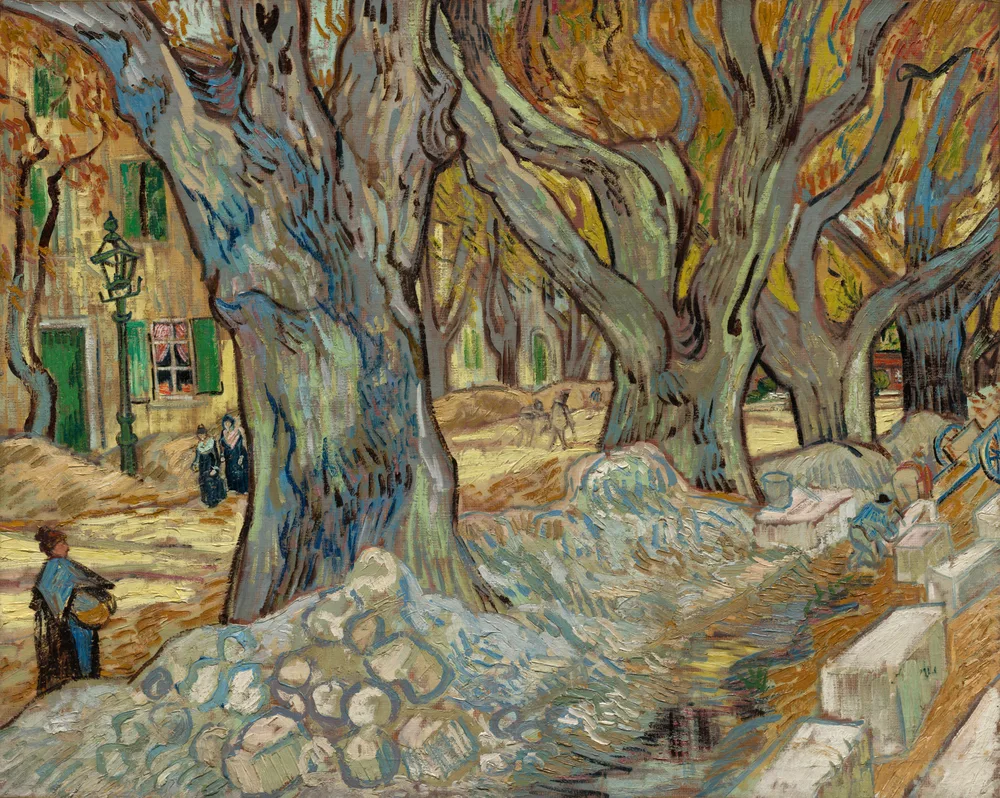
Begin with Vincent van Gogh’s The Large Plane Trees (Road Menders at Saint-Rémy). The Cleveland Museum of Art dates the painting to 1889 and records its medium as oil on fabric. The full title also points to the people repairing the road. The museum’s object record.
Treat the reproduction as a map of movement. Follow the trunks with your eye, then the road and the crowns of the trees. Choose one small area: do the paint marks lead your attention in the same direction as the depicted object? Then return to the whole. A detail should help you see the painting rather than replace it.
Do not automatically attach a specific emotion of the artist to every brush mark. You can note that an arrangement feels restless to you, but that describes your experience of looking. A claim about the artist’s intention would need a different kind of evidence, such as something the artist wrote.
Monet: change the question
Now look at Claude Monet’s Water Lilies (Agapanthus), dated around 1915–1926 in Cleveland. The museum’s object record.
Instead of asking only “what is depicted?”, ask “how is my attention distributed?”. Find a quieter area and a denser one. See whether you can identify a clear starting point or whether you wander across the surface. Compare this way of looking with the previous painting. There is no need to choose a winner; noticing the difference is more interesting.
Ten minutes, five steps
- Minutes 1–2: the whole. Write down your first impression and the place your eye returns to.
- Minutes 3–4: three colours. Name three colours you notice and describe how they sit beside one another.
- Minutes 5–6: one detail. Choose an edge, part of a figure or a tool mark. Describe what you can actually see.
- Minutes 7–8: a question. Note one thing you do not understand. Separate observation from guesswork.
- Minutes 9–10: the label and a return. Read the caption, check its source and look at the whole again. Add one new sentence.
You do not need to keep time to the second. The structure is there to help you slow down rather than turn an encounter with art into a scored task. You can also try it with someone else and compare your notes only at the end.
A screen offers part of the encounter
On a screen, we compare photographs of artworks. Zooming helps reveal details, but it does not replace scale, surface or the presence of the original. For a contemporary work, check the actual dimensions and ask the artist for a photograph of the whole and of a detail. The size of a thumbnail does not tell you the size of the painting.
A useful habit is to add “viewed on a screen” to your note. It lets you revisit that first impression honestly after seeing the work in person. You do not have to defend your earlier opinion; you can develop it.
From looking to choosing
Before your next gallery visit, choose three questions that you actually care about. Which detail would you like to see every day? What does the photograph leave unresolved? What would you ask the artist? A short list like this helps you move from quick browsing towards a considered conversation about art.
In DEMO, begin with The Large Plane Trees, then compare it with Water Lilies. These are museum examples for looking and testing the portal. The displayed prices and commercial terms are fictional; the museum originals are not offered for sale by the gallery.