Sculpture needs space: look from three directions
Silhouette, scale and the viewer’s route. Rodin’s Thinker helps you prepare questions about sculpture, presentation and its place at home.
An educational DEMO example prepared with AI assistance. Facts link to their sources; exercises are editorial suggestions.
It is difficult to stay in one place in front of a sculpture. A step to the side changes the contours, and the open space between parts of a figure becomes part of the encounter. If you are considering a three-dimensional work for your home, begin with this observation: you are also choosing how you will meet the object.
The Thinker: a familiar title, a fresh observation
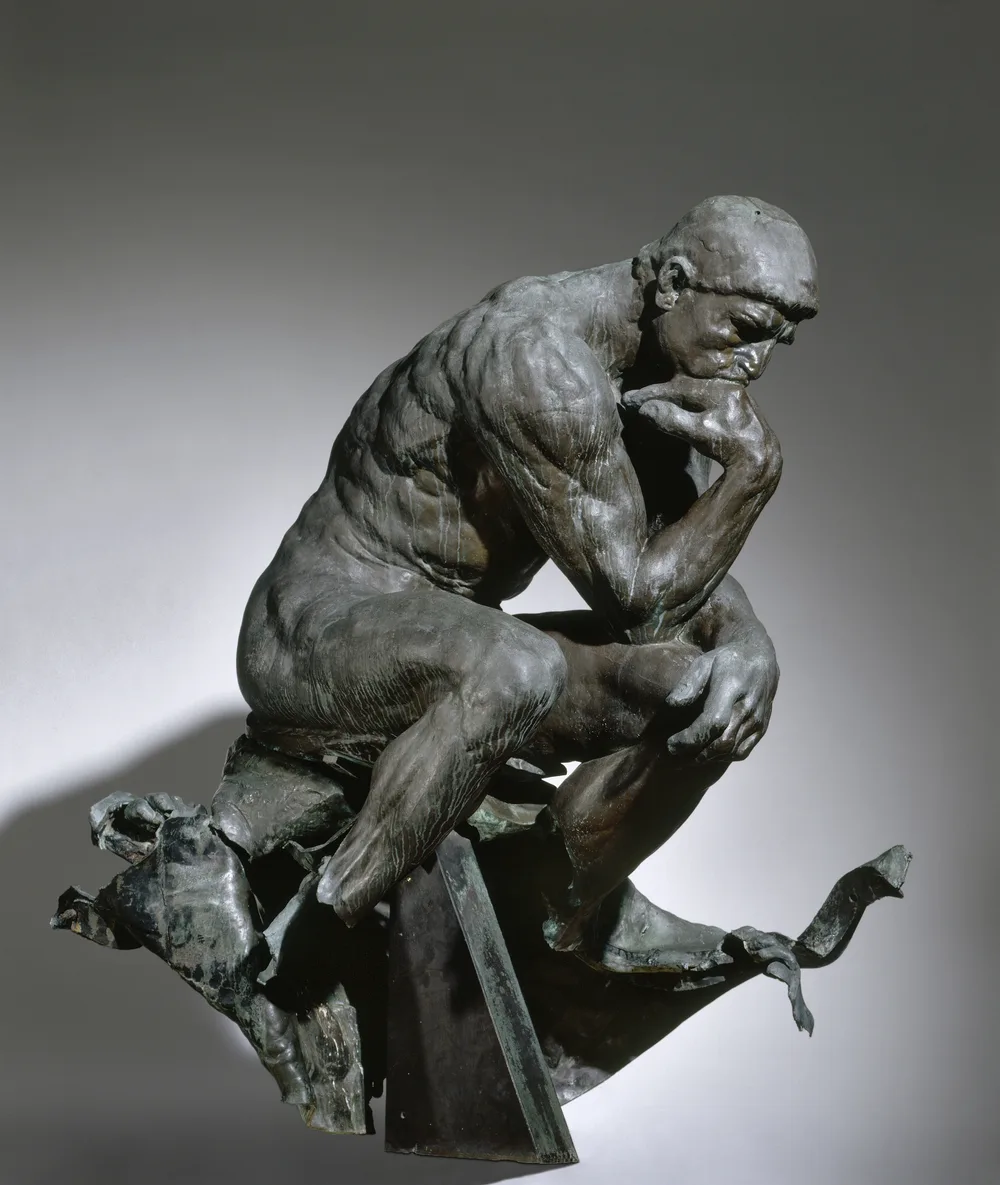
Auguste Rodin’s The Thinker originated in the project for The Gates of Hell. The Musée Rodin describes the figure’s development from part of a larger composition into an independent sculpture. Musée Rodin’s account. The photograph used in DEMO shows the bronze in Cleveland’s collection. The record for this object.
Set the familiar title aside for a moment. Look at the silhouette as an arrangement of masses and gaps. Where does solid form end and open space begin? Can you recognise the direction of the body’s lean before looking closely at the face? These questions do not replace the work’s history, but they help you see it before reading an interpretation.
Three views rather than one photograph
When viewing a contemporary sculpture online, ask for front, side and rear views. Add a photograph showing scale and a detail of the surface. Check that the photographs show the same copy and whether its base is included in the offer.
If you are standing in front of an object, walk around it slowly within the permitted viewing area. Stop at three points and write one sentence about the contour from each. Is the figure equally legible everywhere? Does one part disappear behind another? A photograph from one direction can be excellent while leaving these questions unanswered.
The museum photographs in the DEMO gallery are examples. We do not invent additional views or pretend that a single image documents an object from every side.
In a room, start with the viewer’s route
Draw a simple plan of the place where you want to display the work. Mark the entrance, the route you most often take and the place where you usually sit. Then note the sculpture’s actual dimensions, including its base. Do not judge scale solely from an attractive photograph of an interior.
You can use a lightweight cardboard box to approximate the volume of the proposed object. Treat it only as a visual trial of the space occupied. Check whether you can move around the work and whether other objects would hide it. This model does not test load capacity, stability or safe installation; those conditions need to be agreed with the artist and an appropriate installer.
Questions that make an offer clearer
- What are the three dimensions and the weight of this particular copy?
- Is the base included, and what are its dimensions?
- Which materials were used for the different parts?
- Does the work require specific fixing or display conditions?
- Who arranges transport, moving it into place and any installation?
- Which photographs and documentation accompany this copy?
An answer relating to a specific location is especially useful. “Suitable for interiors” tells you less than a description of the conditions intended for this work. Keep the agreed requirements with the offer.
Detail and scale
A magnified surface can fill a screen even when it is a small part of the object. Note when you are viewing the whole and when you are looking at a detail. Add the actual dimensions from the description to your notes. This helps distinguish the impression created by a photograph from the size of the work.
Return to the first view. Does seeing a detail change how you read the whole form? It is a good moment to ask the artist about the making process without assigning an unverified history to tool marks.
Look and compare
In DEMO, begin with The Thinker, then look at Degas’s Dancer. Compare the arrangement of the figures and the places where your eye supplies the space. Commercial dimensions, weights and prices on the test pages are fictional. Check facts about the museum objects in the linked sources; these originals are not for sale through the gallery.