A print has its own language: Dürer, Hokusai and good questions
From engraved lines to the colour areas of a woodblock print. How to look at prints and distinguish technique, reproduction and a particular copy.
An educational DEMO example prepared with AI assistance. Facts link to their sources; exercises are editorial suggestions.
A print can hold a whole world on a small sheet of paper. It is worth looking twice: first at the composition, then at the traces of a particular technique. This also helps you ask an artist precise questions. Works on paper are not all made in the same way, and the word “print” alone does not explain everything.
Dürer: an image built from lines
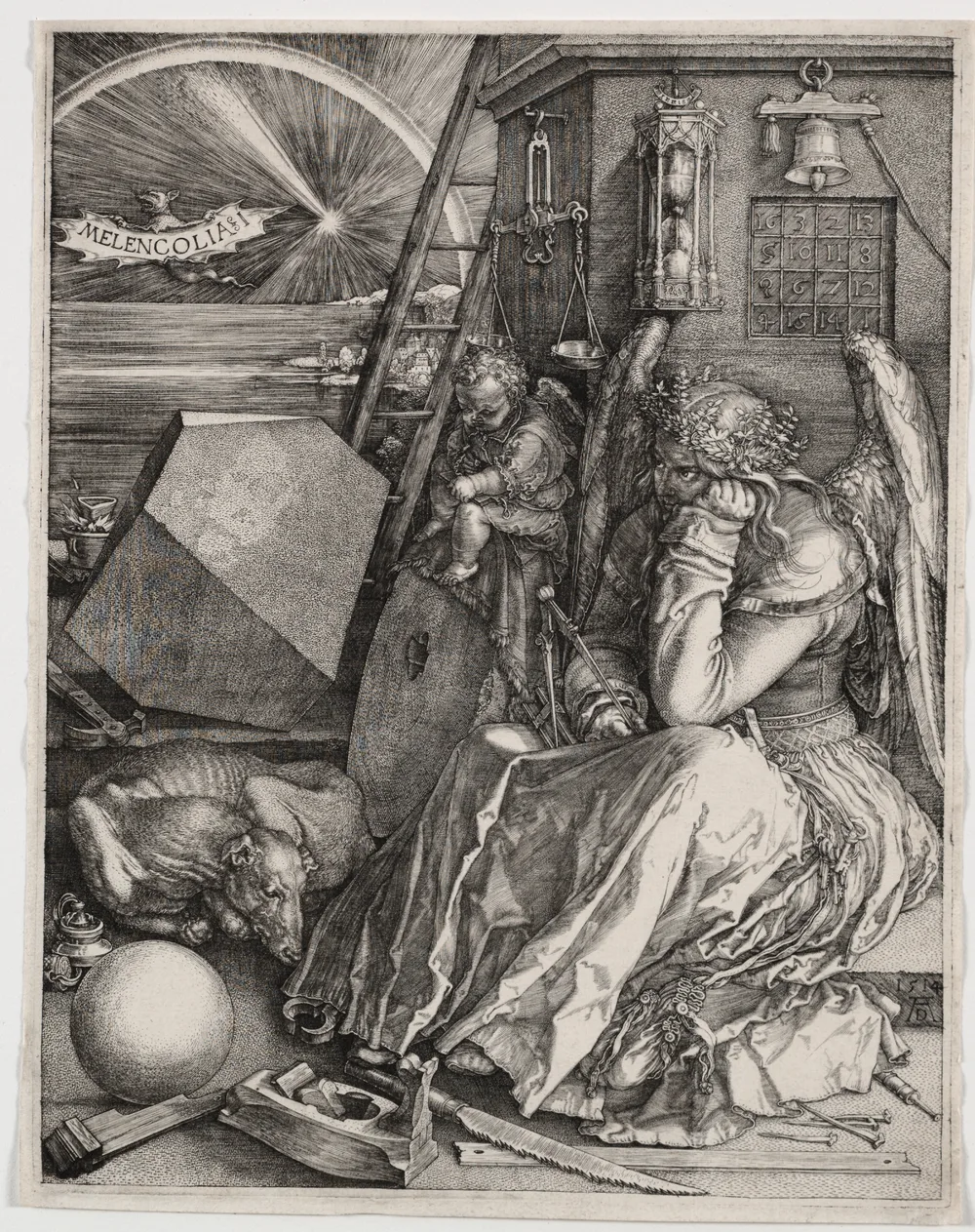
Albrecht Dürer’s Melencolia I, dated 1514, is recorded by Cleveland as an engraving. The museum’s object record. Choose a small area and look for lines running beside one another or crossing. Notice where their density allows you to read a shadow.
Try repeating just the rhythm of those lines with a pencil on your own paper. You do not need to copy the scene: a rectangle the size of a postage stamp is enough. Move the sheet away from you. Do the small marks begin to form a larger patch? This is an exercise in looking, not a reconstruction of Dürer’s working process.
Two techniques, two ways of using a block or plate
In engraving, printing ink sits in lines cut into a metal plate. In woodcut, the raised areas left on a wooden block are inked and printed. The Met’s educational resources explain this basic distinction: engraving and woodcut.
You do not have to identify a technique infallibly from a photograph. Its name in the description is a starting point; if the information is incomplete, ask the artist. A similar-looking line can result from different tools. Rather than guessing, find out what the maker actually did and how they describe the work.
Hokusai: look at the relationship between areas
For comparison, choose Hokusai’s South Wind, Clear Sky from Thirty-Six Views of Mount Fuji. Cleveland classifies it as a colour woodblock print. The museum’s object record.
Put the two reproductions side by side. In one, look for the densest cluster of small marks; in the other, find a boundary between larger areas of colour. Ask how each image directs your eye. This does not mean that engraving is always intricate or woodcut always simplified. You are comparing two particular works, not setting a rule for an entire discipline.
A print, a reproduction and an edition number
Before choosing a contemporary print, ask for three separate details: how the image was made, how it is issued and which particular copy is offered. A number such as 2/20 does not replace an explanation of the process or documentation. A photograph of a signature alone cannot establish authenticity or value.
Useful questions for the artist include:
- What technique was used for the offered work, and who printed it?
- Is it an independent print or a reproduction of another artwork?
- What are the dimensions of the sheet and of the image itself?
- Does the edition have a fixed size, and which number is included in the offer?
- Where is the signature or identifying information for the copy?
- What documentation will accompany the work?
Keep the answers with the specific offer. In DEMO, the type of edition is part of an exercise in using the portal; it does not describe the historical edition of the museum impressions.
A small exercise for your own collection
Make two columns: “I can see” and “the description tells me”. In the first, write three observations about lines, colours or margins. In the second, note the technique, dimensions and information about the copy, together with the source. An empty space in the second column is a useful question for the seller, not an invitation to add your own certain answer.
This method leaves room for curiosity while making a purchase conversation clearer. You can be drawn to an image before knowing how it was made. Afterwards, check that the description matches what is actually being offered.
Compare the works in DEMO
Open Melencolia I and South Wind, Clear Sky. View the complete images, read the museum credits and compare the edition information on the test pages. The museum originals are not for sale. Fictional prices, numbers and specifications simply help demonstrate how the gallery works.