Morris and the rhythm of textiles: beyond ornament
Birds, leaves and repetitions. An exercise in looking at pattern, questions about material and the distinction between a design and its later example.
An educational DEMO example prepared with AI assistance. Facts link to their sources; exercises are editorial suggestions.
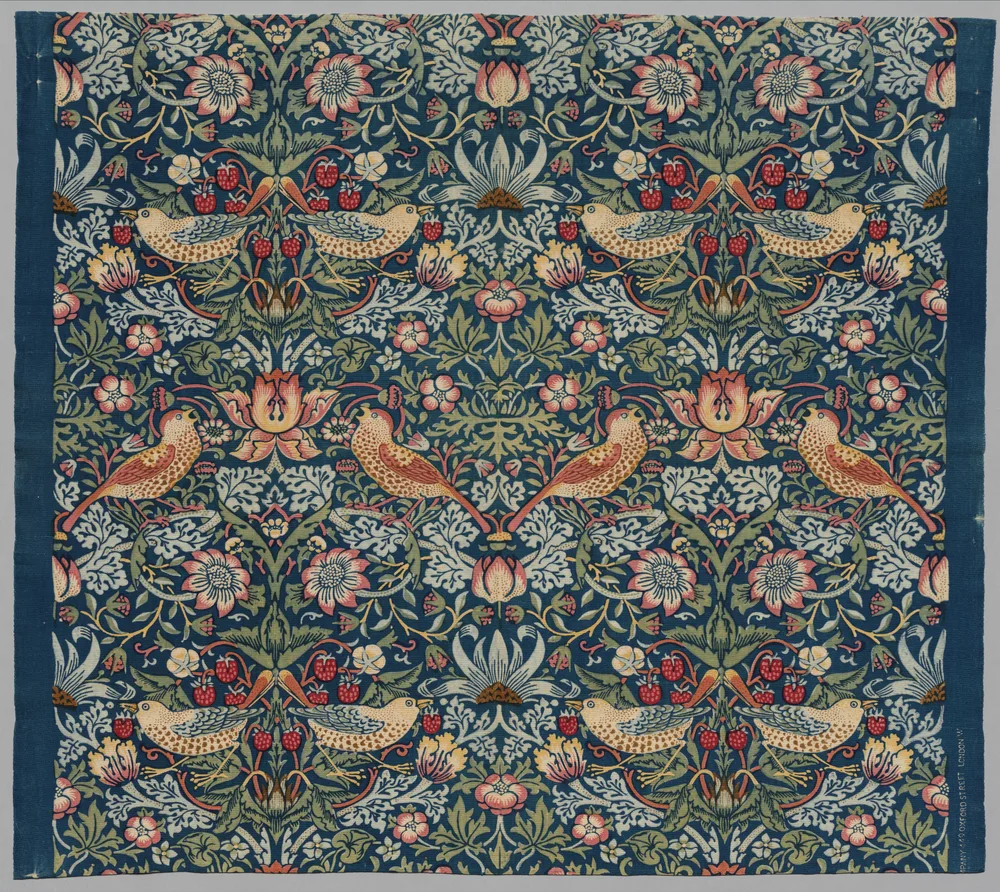
A bird, a leaf, a fruit, another bird. A textile pattern can invite looking as effectively as a framed painting. For a moment, try not to name the things depicted. Notice how repetitions are arranged and what happens between them. It is a useful way to begin an encounter with fibre art.
One pattern, two dates
William Morris created the Strawberry Thief design in 1883; the V&A discusses it in its article on his textiles. The V&A source. Cleveland dates the particular example photographed for DEMO to around 1936. It is a printed cotton textile. The record for this object.
The distinction matters. The date of a design and the date when the object you are viewing was made need not be identical. A caption that separates them helps you understand the work. It does not automatically imply that the designer personally made the piece of fabric shown.
Find your own unit of repetition
Choose a motif in the reproduction and find its next appearance. Try identifying the direction of repetition: horizontal, vertical or offset. You do not have to reconstruct the technical pattern repeat. Begin with what you can observe in the photograph.
Then look at the space between the motifs. Does the background remain a separate field, or does it interweave with the plants? Shift your attention from birds to leaves and look at the whole again. This simple exercise shows how the same image can offer several routes for your eye.
A pattern does not yet describe the material
Imagine two objects with a similar ornament: a flat print and a textile. The recognisable motif might be the same, but the questions about the objects differ. For a textile work, you need information about fibres, technique and presentation. A photograph of the pattern cannot answer every question.
Also ask whether you are viewing the complete work or a section of a larger surface. With a unique textile artwork, do not assume that its motif repeats beyond the frame. Repetition can be one of the artist’s choices rather than a compulsory feature of the discipline.
Trying a textile in a room
Before matching colours to a sofa, check scale. Write down the actual dimensions and imagine them on the intended wall. On your own sketch, mark the furniture and the space around the work. “Will I be able to read this motif from where I sit?” is more practical than judging a small thumbnail.
Prepare two possible arrangements: a quieter one with more open background, and a denser one with other objects nearby. Neither has to be the single correct answer. See which better suits the way you want to look at the work. Agree fixing and display conditions with the artist.
Five questions for the maker
- Which fibres and materials were used?
- What is the name of the technique?
- Do the stated dimensions include fixing or framing?
- Does the photograph show the whole of this particular copy?
- How does the artist intend it to be displayed, and what instructions accompany it?
Keep the answers with the work’s description. When something is unknown, write “to be confirmed” rather than borrowing specifications from a similar object. A familiar pattern is not evidence of composition or the date of manufacture.
An exercise at three distances
Look at the reproduction as a small image, at full frame and magnified. At each scale, write down what you see first. Compare your notes: do you begin with rhythm, a bird or the relationship between shapes? Apply the same method to the next work that catches your attention.
In DEMO, open Strawberry Thief, then the tapestry with golden lions. You are comparing photographs of museum objects, not two real sale offers. The catalogue’s test prices and specifications remain fictional.