Light held in glass: Gallé and Tiffany
Contour, surface and colour. How to look at glass, compare photographs and ask an artist about presenting a particular work.
An educational DEMO example prepared with AI assistance. Facts link to their sources; exercises are editorial suggestions.
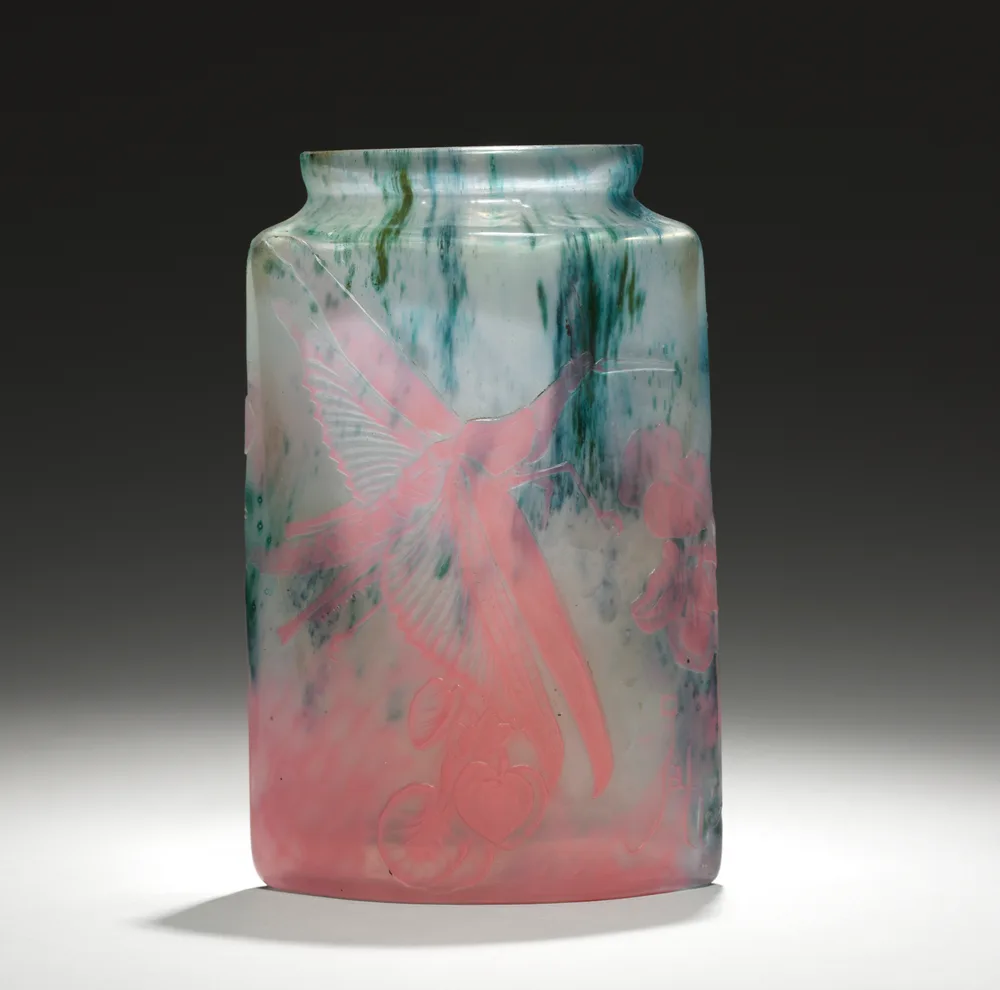
A glass object in a photograph can be both a thing and an image of light. You see its outline, but also what happens on the surface and within it. To look more closely, separate these three layers. You do not need a specialist vocabulary to begin: a few specific observations are enough.
Gallé: form, colour and relief
Cleveland dates Émile Gallé’s vase to around 1900. The museum describes its medium as glass with pink and green inclusions, cameo cut. The museum’s object record.
First follow the outer contour. Then choose a part of the decoration and notice what lets you read it as raised. Finally, look at the relationships between colours. Do not try to explain every technical effect from one reproduction. You can observe a change of colour without yet knowing exactly how it was achieved.
Tiffany: the same discipline, a different question
The Met records a vase designed by Louis Comfort Tiffany as Favrile glass. Its description discusses the surface effects of that particular object. The Met’s account of the vase.
In DEMO, you can view a separate Tiffany vase from Cleveland. Do not transfer information from one museum’s object to another. Instead, compare the questions you ask of the photographs: does the contour, ornament or surface attract you first? Note the difference without immediately making a ranking.
Photographs and viewing conditions
For contemporary glass, ask for a full view against a quiet background and a detail. Check that the photographs show the same copy and ask about the conditions in which they were taken. A reflection may make one part difficult to assess, so a specific request for another view can be more useful than a guess.
Do not judge transparency or colour solely from a heavily styled setting. Leave room for questions about how the work appears outside a photographic session. Good documentation helps you discuss the object, but it remains photographic documentation.
A small trial for an interior
On a sketch of a shelf or alcove, mark the proposed work’s actual dimensions. Add neighbouring objects and the direction from which you would usually see it. Make another version with fewer things around it. Compare where it is easier to imagine a clear contour.
This is an exercise in visual arrangement. It does not establish safe display conditions or replace the artist’s instructions. Suitable support, fixing and location requirements need to be agreed for the specific object. Do not use a museum example as instructions for handling your own artwork.
What to keep with an offer
- The full name of the material and technique supplied by the maker.
- The height, width, depth and weight of the specific work.
- Whether the photograph shows the whole or a detail.
- A description of markings, signature and documentation.
- The agreed arrangements for transport and handover.
- Display instructions supplied by the artist.
Do not infer a functional purpose solely from the shape of a vessel. If you want to use it as a vase containing water, ask directly about that use. Its name and appearance are not a separate declaration by the maker about functionality.
Three sentences rather than a quick impression
After viewing a reproduction, write “first I notice…”, “in the detail I can see…” and “I would like to ask about…”. The first two preserve your experience; the third opens a conversation. You do not need to know every technical term to ask a good question.
Return to Gallé’s vase and compare it with Tiffany’s. The sources describe historical museum objects. The test catalogue demonstrates gallery functions, so its prices, commercial dimensions and terms are fictional. Neither museum original is offered for sale through the portal.