Collage: fragments and the art of placing things together
Begin with Schwitters to explore layers, edges and meanings. Try an exercise of your own: six paper fragments in three different arrangements.
An educational DEMO example prepared with AI assistance. Facts link to their sources; exercises are editorial suggestions.
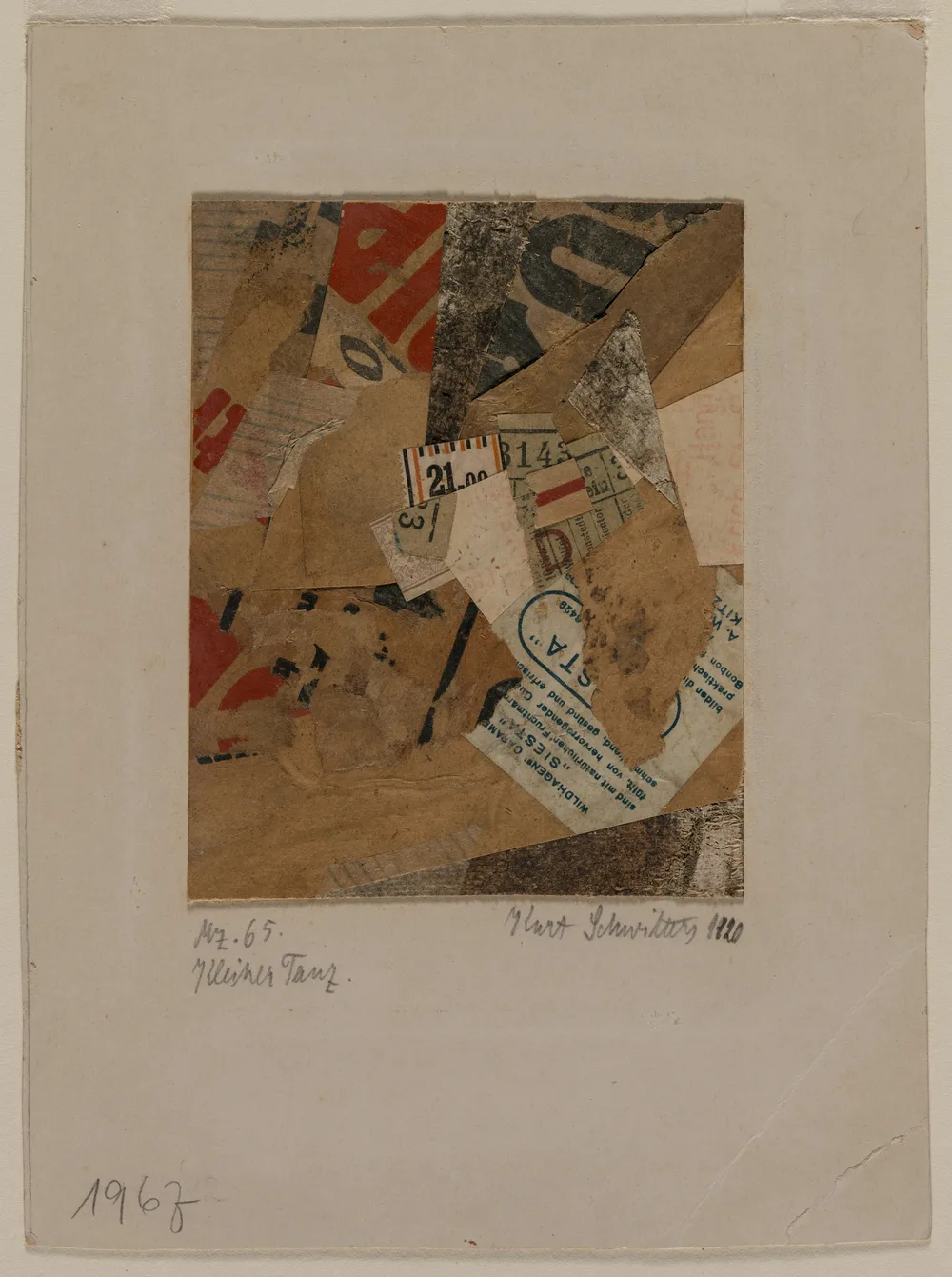
A printed scrap, an edge of another colour, a trace of earlier use. Collage invites you to look at relationships between elements that may not originally have belonged together. You can begin with one fragment, but its neighbours matter just as much. This article suggests ways of looking and ends with an exercise using paper of your own.
What do we call collage?
MoMA describes collage as both a technique and the resulting work, in which pieces of paper or other materials are arranged and attached to a support. MoMA’s glossary. For a particular work, you still need information about the materials used. The technique’s name does not explain every layer.
In DEMO, you view photographs of these objects. A reproduction shows a composition but is not the same object as a work with attached fragments. This distinction is useful when an artist offers an original, a reproduction or a separate edition.
Schwitters: read the arrangement before the text
Kurt Schwitters’s Little Dance, dated 1920, is recorded as a collage in Cleveland’s collection. The museum’s object record. Start with the largest areas and the places where pieces overlap. Only then look closely at words and smaller marks.
Describe an edge: is it straight, torn or hidden by another element? Notice whether it leads your eye onwards or brings it to a stop. These questions help you see compositional choices without inventing an unverified story about the origin of every scrap.
Material can become part of the subject
Choose one fragment with visible print and another without it. First compare their colours, sizes and positions. Then ask whether a legible word changes your attention. Separate “I can see lettering” from “this word makes me think of…”.
You do not have to settle on a single correct interpretation. A useful note can contain several possibilities and make their uncertainty clear. A museum source lets you check a title, attribution or material; your association remains your own suggested reading.
An exercise: six fragments, three arrangements
Choose six pieces of your own unwanted paper: two quiet ones, two with print and two with a strong colour. Use material intended for the exercise, rather than documents, photographs or someone else’s originals that you want to keep.
- Arrange the pieces without gluing them, creating a clear centre.
- Make a second arrangement that distributes attention across several places.
- In the third, leave more empty support between the elements.
- Photograph each version and note what changes when you move one fragment.
You do not need to finish with a completed artwork. The exercise shows how a small change of neighbours affects the whole. You can look at the three photographs the following day and see whether you still prefer the same arrangement.
Questions about contemporary mixed media
Before choosing a work, ask about materials and support, actual dimensions and presentation. Check whether the offer concerns the original object or a reproduction of its photograph. If the work includes several elements, ask for a description of exactly what is included.
A full view and details help you understand the arrangement of layers. Do not draw your own conclusions about the durability of joins from a photograph. Display instructions and documentation come from the artist for the specific work.
A way of looking you can take with you
After the exercise, return to Little Dance. Do you now notice gaps, edges or repeated colours more often? Add a sentence to your first note. The aim is not to prove that you now “understand collage”, but to gain another way of looking.
In DEMO, open Little Dance and María Blanchard’s Still Life. Compare compositions and check materials in the museum captions. Fictional commercial specifications demonstrate the portal; the museum originals are not offered for sale through it.