Photography in a collection: what to check
An image and a print raise different questions. Stieglitz helps us read dates, techniques, formats and the details of a particular copy.
An educational DEMO example prepared with AI assistance. Facts link to their sources; exercises are editorial suggestions.
You recognise a photograph, but what exactly does its caption describe? The image, the moment it was taken, the printing technique or a particular sheet? It helps to separate these questions. They are useful both when viewing a museum collection and when speaking with a photographer today.
One photograph, different prints
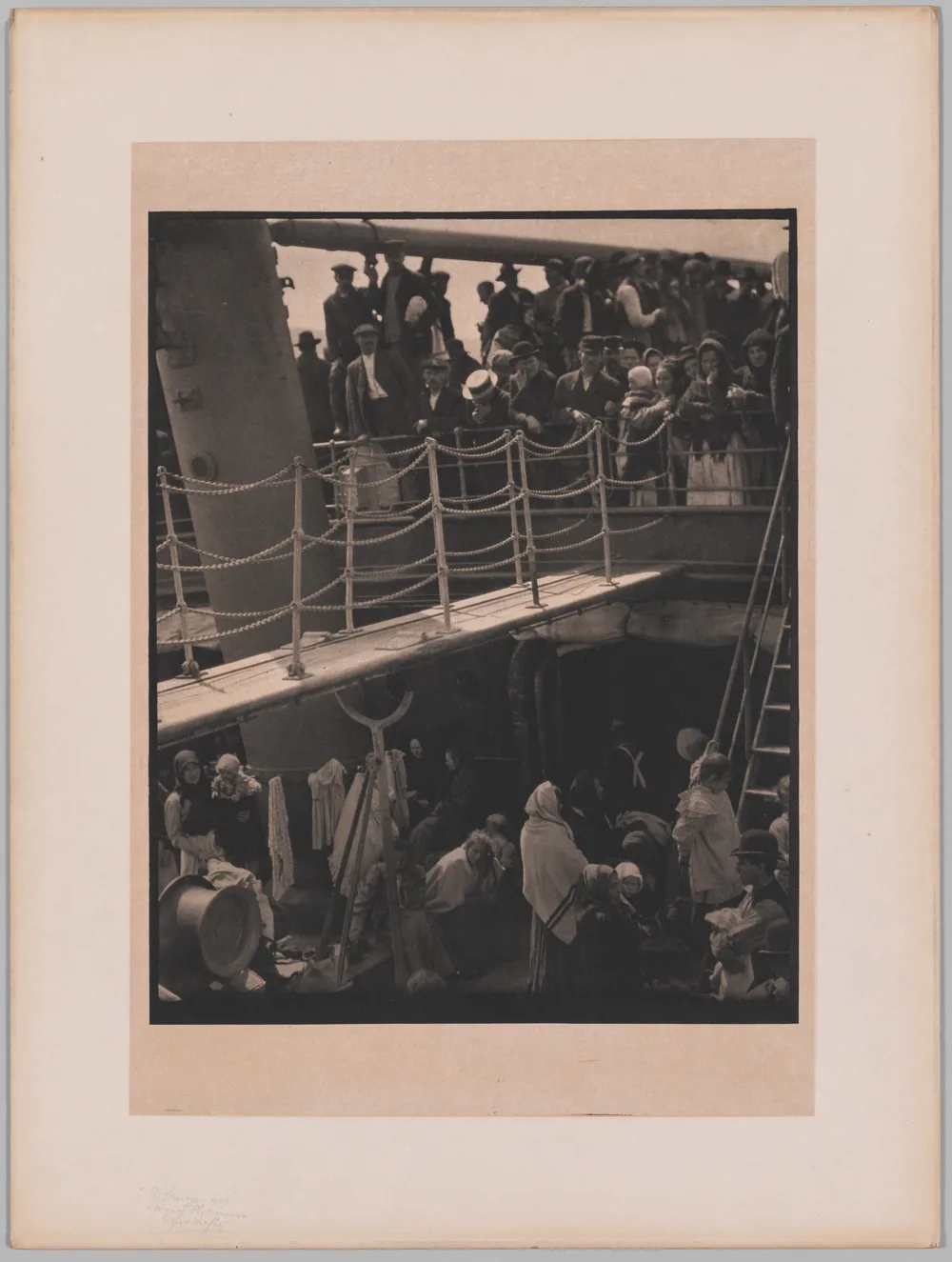
Alfred Stieglitz’s The Steerage dates from 1907. Cleveland records its example as a photogravure. Cleveland’s object record. The Met also holds an impression of the image whose record separately gives 1907 for the photograph and 1915 for the print. The Met’s object record.
These entries show why recognising an image is not enough to describe an object. We do not transfer a printing date from one museum’s copy to another. Where a source provides only one date, we preserve that entry rather than inventing a printing date ourselves.
Composition first, object details next
Open the reproduction and look for directions that organise the frame. Choose a line and one bright or dark area. Describe their relationship without immediately explaining the whole history of the scene. Read the caption afterwards and compare which questions it answers and which remain open.
This sequence leaves room for your observations without confusing them with facts. “This area directs my eye” describes looking. “The photographer certainly intended to say…” assigns an intention that the arrangement of the frame alone does not prove.
What exactly is being offered?
For a contemporary photograph, ask for a description of the particular object: technique, support, dimensions of the image and sheet, printing date, edition information and signature. Check whether it is framed and whether the photographs show that specific copy.
“Fine art photography” is not a substitute for these details. Two offers may use the same image but refer to different formats or editions. Do not treat them as identical simply because their thumbnails look alike.
Questions before choosing
- When was the photographic image made, and when was the offered print produced?
- What is the full name of the technique and support?
- What are the dimensions of the image, sheet and any frame?
- Is it a limited edition, and which number will you receive?
- Where is the signature or identifying mark for the copy?
- Does the artist supply documentation and their own display instructions?
“Not established” is useful information too: it identifies a gap. Do not turn missing data into a default date or an assurance about technique. Keep the answers with the accepted offer when making a purchase.
Look at two kinds of detail
An image detail helps you see how the frame is constructed. An object detail may reveal a margin, a marking or part of the surface. Both are useful, but for different questions. Before asking the artist, explain what you want to learn rather than requesting a “better photograph” in general.
For example, “please show the whole sheet with its edges visible” is a specific request about format. “Please show a close-up of this copy’s signature” concerns identification. Neither view alone settles the work’s authenticity.
Two columns in a notebook
On the left, write three things you notice in the composition. On the right, put the print details given by the source. Underline an item that refers only to that particular copy. This small exercise helps you look beyond the image and see a photograph as a specific work on a particular support.
Compare in DEMO
Look at The Steerage, then Cameron’s portrait of Julia Jackson. You do not need to judge them on a single scale. Compare your own questions about framing and the information in their museum captions.
DEMO uses these photographs as educational examples. Prices and edition types in the commercial fields are fictional, and the museum copies are not for sale. In this exercise, historical information comes from museum records rather than the test basket.